

Robot Rental Maintenance: Record a Discovery Mismatch
2026-11-01
Robot Rental Maintenance: Record a Discovery Mismatch
A rental software demonstration may show a component running while the expected peer is absent from the observer's view. The maintenance note should not immediately describe a broken robot or an unavailable supplier service. It first needs to identify the discovery context of the components being discussed. This article develops a fictional documentation incident and changes no network, domain setting or connected equipment.
Identify the two sides of the missing-peer observation
Suppose a supplier provides a demonstration extract and the receiving team reports that it cannot see the expected peer. Record what the supplier's material shows and what the receiver actually observed. A process appearing in a screen recording and a peer appearing in a discovery view are different observations. Keep their sources and conditions visible rather than merging them into one statement that the rental system is online.
The original note can name the software configuration under discussion without exposing private network information. Where the permitted evidence does not identify a component, mark it unknown and request clarification from the responsible party. Do not substitute a similarly named component from another demonstration simply because it makes the narrative easier to complete.
Preserve the ROS domain context as a condition
The Jazzy ROS Domain ID explanation describes logical separation between ROS 2 domains and the role of a shared domain in discovery. This makes domain context relevant to a missing-peer investigation. It is not a suggestion to change an unfamiliar rental installation to another domain in order to see what happens.
Ask the supplier to explain which domain context applies to the approved demonstration and which context was present in the recorded observation. If the record does not contain that information, leave it pending. An unchanged product name or a shared physical network does not itself supply the missing context.
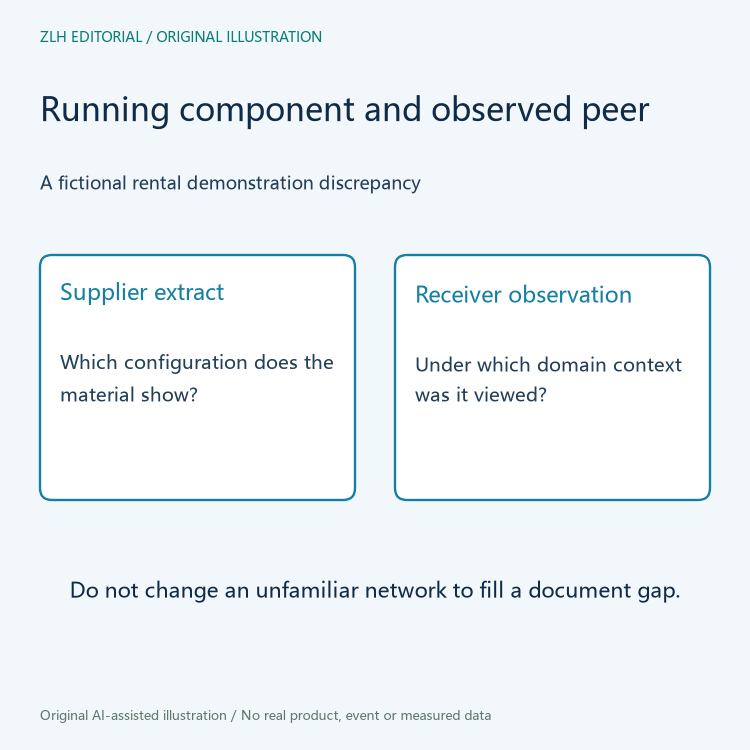
Any later configuration adjustment belongs to an authorized maintenance procedure with its own responsibility and result. This article does not propose a domain number, open a firewall or alter a production environment. Documentary clarification can occur before any operational change is considered, and the note should make that sequence clear.
Discovery and useful communication remain distinct findings
The Jazzy discovery documentation describes middleware discovery and notes the compatibility conditions involved in establishing connections. A common domain therefore should not be written as a universal guarantee that the application's expected messages will be received. The actual observation still needs to be recorded under its own conditions.
In the imagined investigation, the responsible team might later observe the peer while still needing to examine the intended application exchange. The maintenance entry should keep those findings separate. Do not promote a discovery observation into a statement that the robot is ready for every rental task or that all communication paths have been tested.
Conversely, an absent peer in one view does not establish that the supplier's demonstration was fabricated. The appropriate next question is which conditions and observation methods differed. Record the answer when evidence is provided. Until then, retain the difference as an unresolved relationship rather than assigning blame to a component or organization.
Hand over a narrow recheck and its actual result
If an authorized recheck is arranged, identify the agreed software configuration, the observation method and the question it is meant to answer. Keep the earlier missing-peer note alongside the later result. A successful recheck may explain a particular condition without reconstructing every aspect of the earlier demonstration.
The receiver can also record a supplier clarification that resolves only the documentation gap. For example, the supplier may identify which extract belongs to the agreed rental configuration. That clarification is useful, but it is not the same as a live communication test. The handover should allow a later operator to tell which kind of work was completed.
A handover between rental staff and software maintainers can assign the documentation question before scheduling further activity. The rental team can identify the agreed demonstration pack, while the software maintainer can explain the observation conditions. Retain both answers. A general statement that the same machine was used does not establish that the relevant software context was unchanged.
When a supplier provides a new demonstration recording, identify whether it supplements the earlier one or replaces an incorrectly associated extract. That documentary relationship helps the next receiver understand which material to use. It should not be converted into an assumption that the receiving environment was changed or that an operational problem was repaired.

A closing entry should state whether the domain context is now understood, whether discovery was actually observed and what application behaviour remains unexamined. No peer list or test result is supplied in this article. Its original diagrams contain no network addresses or operational settings.
Related background is available in the robot rental software section and the article directory. A precise discovery record gives the rental team a practical starting point for authorized follow-up while keeping documentation, peer observation and operational acceptance from being treated as one interchangeable assurance.


