

Robot Rental Records: Separate Dates from Elapsed Time
2026-11-02
Robot Rental Records: Separate Dates from Elapsed Time
Robot rental records may use a date to name a service day, a local time to arrange an appointment, or an interval to describe elapsed time. Those are different ways of describing a booking. This practical article proposes an offline exercise for an imaginary rental office. It does not interpret a real contract, calculate a charge, or convert an actual customer appointment. The aim is to make the intended time question explicit before selecting a calculation.
Ask what the booking expression is meant to represent
Begin with an empty training form rather than a real reservation. Give each time-related field a plain-language purpose. A field naming a calendar date should be described as such; a field identifying a particular appointment should say which activity it concerns. The form should not use one unexplained label for every purpose.
For the fictional office, the learner might ask whether the record describes a collection arrangement, a return arrangement, or a named service period. These labels organize the discussion. They do not establish how any real provider counts days or what a customer owes.
If the purpose is unclear, keep the field unresolved. A software library can manipulate an expression without deciding the commercial meaning behind it. The exercise should obtain that meaning from the responsible person instead of inferring it from the appearance of a date.
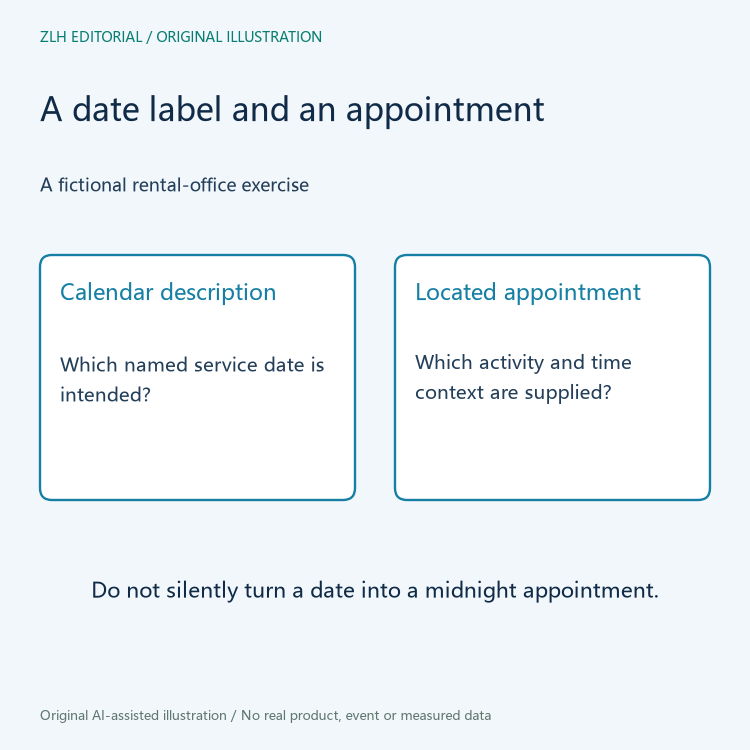
Distinguish calendar descriptions from located moments
The Python datetime documentation distinguishes aware and naive date-time objects. This helps explain why a familiar-looking date and clock display may not, on its own, identify an unambiguous moment. The fictional form should make its intended information requirements clear.
A date used as the name of a service day need not be silently rewritten as a midnight appointment. That rewrite would add an interpretation the original field may not have supplied. Likewise, an appointment field should not lose information merely because the public schedule displays only a shorter label.
The proposed exercise keeps the source description beside any working representation. Learners can then explain which information was supplied and which decisions were made for the task. No real booking details, location, or customer identity are needed.
Treat local-clock changes as a reason to state the question
The zoneinfo documentation describes time-zone transitions and handling of ambiguous local times. An exercise involving zoned appointments should therefore explain the relevant context instead of assuming that every repeated clock label refers to one identical moment.
This article does not choose an ambiguous appointment or supply a numerical example. An instructor could prepare suitable authorized teaching material, then ask learners which further explanation is needed before interpreting it. The exercise should not make an arbitrary choice and hide that choice inside a formatting step.
Nor does a time-zone database define a rental policy. It can support a stated time interpretation, while the meaning of a service period remains a separate question. A technical representation should not be used to invent terms that the fictional office has not specified.
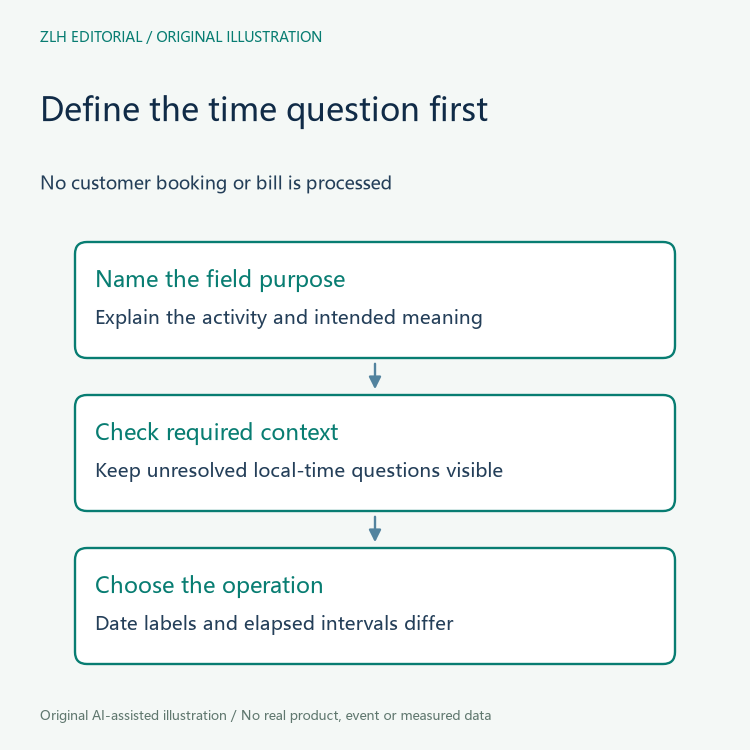
Keep the requested interval different from a date label
If the training task eventually asks about elapsed time, it must first identify the intended endpoints with sufficient context. If it instead asks which calendar dates a schedule names, the learner should answer that question. The two tasks should not be combined merely because the same form contains both kinds of fields.
For the imaginary office, a useful review can ask what each proposed operation preserves and what it assumes. Does it retain the original activity label? Does it require information the source did not provide? These questions expose a gap before it becomes a confident-looking duration.
No calculation has been performed here. The diagrams contain no booking dates or interval values. Their purpose is to distinguish the questions, so a learner can choose a suitable method only after the relevant meaning is established.
Leave commercial conclusions with their actual basis
A completed classroom explanation can help people communicate about time fields. It cannot determine a real bill, an overdue status, or the meaning of a provider’s agreement. Those conclusions require their own actual terms and information, which this article has not examined.
At the end, ask a second learner to explain whether each field names a date, an appointment, or a requested interval. An unanswered field should remain visible. A clear question is preferable to a complete-looking form built from guesses.
More topics appear in our robot rental scope section and the article directory. Both original illustrations are qualitative teaching aids, with no real customer booking, time conversion, duration, price, or contractual assessment.


